


August 4, 2026
As Sri Lanka commemorates National Logistics Day on 16 August, the logistics sector continues to evolve as a strategic enabler of economic growth, trade facilitation and supply chain resilience.
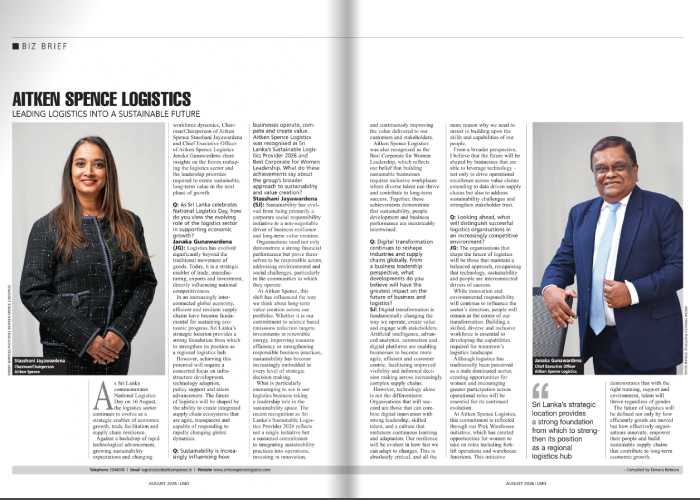
Against a backdrop of rapid technological advancement, growing sustainability expectations and changing workforce dynamics, Chairman/Chairperson of Aitken Spence Stasshani Jayawardena and Chief Executive Officer of Aitken Spence Logistics Janaka Gunawardena share insights on the forces reshaping the logistics sector and the leadership priorities required to create sustainable, long-term value in its next phase of growth.
Q: As Sri Lanka celebrates National Logistics Day, how do you view the evolving role of the logistics sector in supporting economic growth?
Janaka Gunawardena (JG):Logistics has evolved significantly beyond the traditional movement of goods. Today, it is a strategic enabler of trade, manufacturing, exports and investment, directly influencing national competitiveness.In an increasingly interconnected global economy, efficient and resilient supply chains have become fundamental for sustaining economic progress. Sri Lanka’s strategic location provides a strong foundation from which to strengthen its position as a regional logistics hub.
However, achieving this potential will require a concerted focus on infrastructure development, technology adoption, policy support and talent advancement. The future of logistics will be shaped by the ability to create integrated supply chain ecosystems that are agile, transparent and capable of responding to rapidly changing global dynamics.
Q: Sustainability is increasingly influencing how businesses operate, compete and create value. Aitken Spence Logistics was recognised as Sri Lanka’s Sustainable Logistics Provider and Best Corporate for Women Leadership. What do these achievements say about the group’s broader approach to sustainability and value creation?
Stasshani Jayawardena (SJ): Sustainability has evolved from being primarily a corporate social responsibility initiative to a non-negotiable driver of business resilience and long-term value creation.
Organisations need not only demonstrate a strong financial performance but prove themselves to be responsible actors, addressing environmental and social challenges particularly in the communities in which they operate.
At Aitken Spence, this shift has influenced the way we think about long-term value creation across our portfolio. Whether it is our commitment to science-based emissions reduction targets, investments in renewable energy, improving resource efficiency or strengthening responsible business practices, sustainability has become increasingly embedded in every level of strategic decision making.
What is particularly encouraging to see, is our logistics business taking a leadership role in the sustainability space. Their recent recognition as Sri Lanka’s Sustainable Logistics Provider reflects not a single initiative but a sustained commitment to integrating sustainability practices into operations, investing in innovation and continuously improving the value delivered to our customers and stakeholders.
Aitken Spence Logistics was also recognised as the Best Corporate for Women Leadership, which reflects our belief that building sustainable businesses requires inclusive workplaces where diverse talent can thrive and contribute to long-term success. Together, these achievements demonstrate that sustainability, people development and business performance are inextricably intertwined.
Q: Digital transformation continues to reshape industries and supply chains globally. From a business leadership perspective, what developments do you believe will have the greatest impact on the future of business and logistics?
SJ: Digital transformation is fundamentally changing the way we operate, create value and engage with stakeholders. Artificial intelligence, advanced analytics, automation, and digital platforms are enabling businesses to become more agile, efficient and customer centric, facilitating improved visibility and informed decision making across increasingly complex supply chains.
However, technology alone is not the differentiator. Organisations that will succeed are those that can combine digital innovation with strong leadership, skilled talent, and a culture that embraces continuous learning and adaptation. Our resilience will be evident in how fast we can adapt to changes. This is absolutely critical, and all the more reason why we need to invest in building upon the skills and capabilities of our people.
From a broader perspective, I believe that the future will be shaped by businesses that are able to leverage technology, not only to drive operational excellence across value chains, extending to data driven supply chains but also to address sustainability challenges and strengthen stakeholder trust.
Q: Looking ahead, what will distinguish successful logistics organisations in an increasingly competitive environment?
JG: The organisations that shape the future of logistics will be those that maintain a balanced approach, recognising that technology, sustainability and people are interconnected drivers of success.
While innovation and environmental responsibility will continue to influence the sector’s direction, people will remain at the centre of our transformation. Building a skilled, diverse and inclusive workforce is essential to developing the capabilities required for tomorrow’s logistics landscape.
Although the logistics sector has traditionally been perceived as a male dominated sector, creating opportunities for women and encouraging greater participation across operational roles will be essential for the sector’s continued evolution. At Aitken Spence Logistics, this commitment is reflected through our Pink Warehouse initiative, which has created opportunities for women to take on roles including forklift operations and warehouse functions. This initiative demonstrates that with the right training, support and environment, talent will thrive regardless of gender.
The future of logistics will be defined not only by how efficiently goods are moved but by how effectively organisations innovate, empower their people and build sustainable supply chains that contribute to long-term economic growth.
